Survivor 51 Cast by the Numbers: Which Jobs, Ages, and Backgrounds Actually Win Survivor?
The Survivor 51 cast has two attorneys, an OBGYN, a pro wrestler, a Grey’s Anatomy actor, a Navy lawyer, an HR executive, and a mental health therapist. History says only one of those job categories consistently produces winners. Can you guess which one?

Never Miss Your Chance to Audition!
Join our WhatsApp Channel for exclusive casting calls and audition alerts!
Join NowHint: it isn’t the doctor.
Fifty seasons of Survivor, fifty winners — and a Bureau of Labor Statistics analysis that quietly mapped the whole thing — now give us something most pre-season coverage skips entirely: a data-backed read on who the S51 cast members actually resemble when you compare them against every winner who came before them. That’s what this article does.
The Data: Which Professions Have Won Survivor Most Often?
In June 2025, the U.S. Bureau of Labor Statistics published a detailed occupational analysis of Survivor winners from Seasons 1 through 48. The findings surprised even longtime fans.
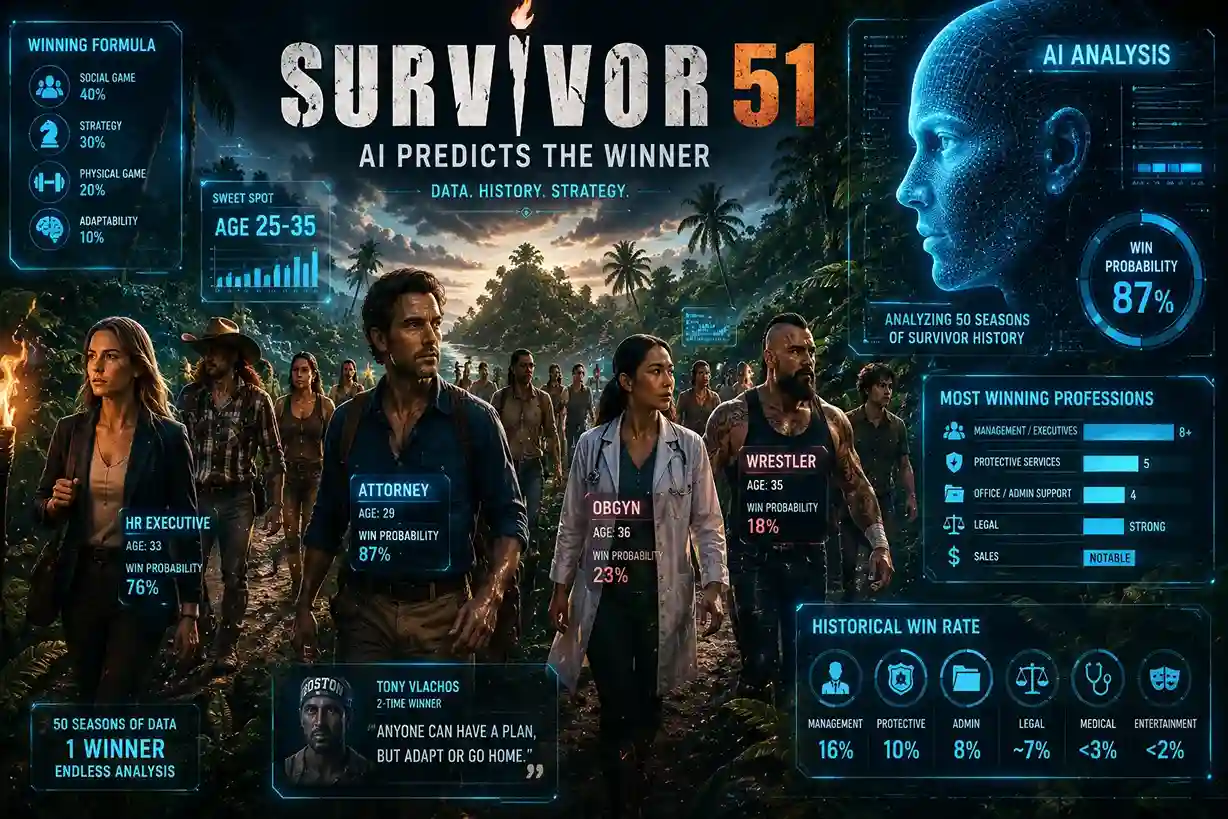
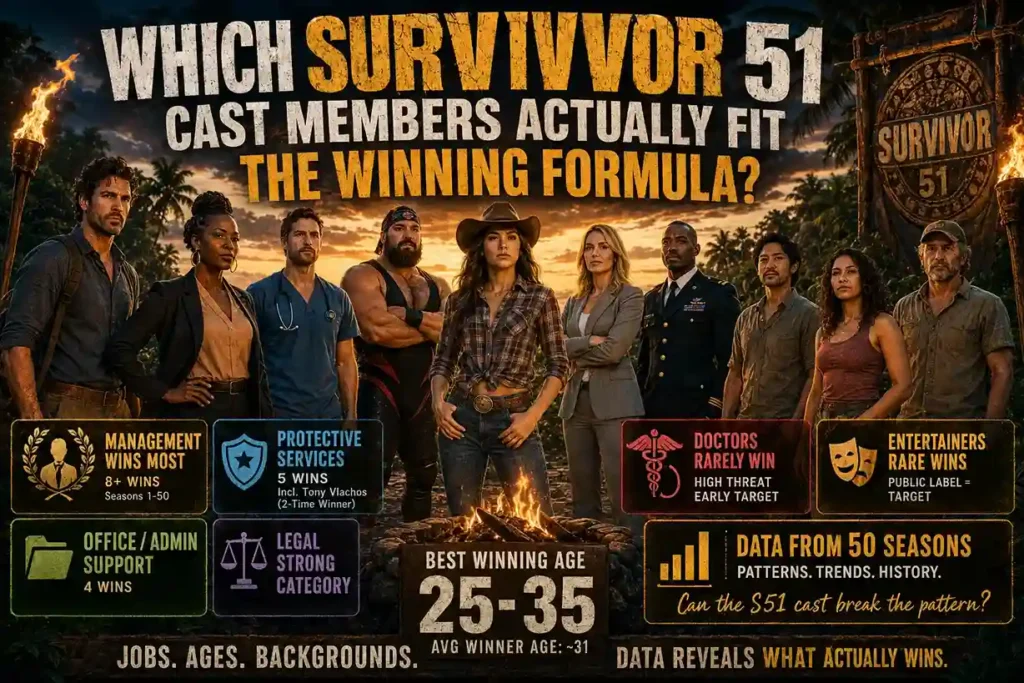
Management and executives top the board — by a wide margin. Eight winners came from management-category roles: CEOs, VPs, directors, and other people whose daily work involves persuading, coalition-building, and navigating competing agendas.
Yul Kwon (Season 13), for example, was a management consultant. His approach to the game — meticulous, relationship-first, strategically precise — mirrors what you’d expect from someone who makes their living reading rooms for a living.
Protective services rank second. Police officers, firefighters, and security workers account for five wins. The most famous example is Tony Vlachos, a New Jersey cop who is the only person in Survivor history to win the game twice (Seasons 28 and 40).
Physical toughness matters, but what the data actually captures here is the loyalty narrative: protective services workers project trustworthiness and dependability — qualities juries reward.
Office and administrative support roles claim third place with four wins. This is the category that surprises people.
“Admin” doesn’t sound like a winning archetype, but it makes sense on reflection: these players rarely arrive with a threatening label, they’re often underestimated, and they tend to be skilled at managing relationships quietly.
Here’s the full picture, ranked:
| Profession group | Wins (S1–S50) | Notable winner |
|---|---|---|
| Management / executives | 8+ | Yul Kwon, Kim Spradlin |
| Protective services (police/fire) | 5 | Tony Vlachos (x2) |
| Office / admin support | 4 | Various |
| Legal (attorneys) | Strong | Sarah Lacina (cop/lawyer crossover) |
| Sales (incl. pharma) | Notable | Natalie White |
| Athletes / coaches | Mixed | J.T. Thomas |
| Medical / doctors | Low | Very few |
| Entertainers / actors | Rare | Essentially none |
Sources: BLS Occupational Employment and Wage Statistics analysis (June 2025); Survivor Oz career data; individual season records.
Why management wins
The reason management workers dominate isn’t surprising once you think about it: their job is Survivor, minus the island.
They manage competing interests, build coalitions without making enemies, and communicate decisions in a way that makes other people feel included.
When the jury sits down to vote, they’re looking for someone who “played the best game” — and the person who played a boardroom social game for 26 days tends to fit that description neatly.
Why protective services win
Tony Vlachos aside (who won through pure chaotic genius more than any occupational trait), cops and firefighters bring something underrated to the game: a “you can trust me with your life” quality.
In a game built on deception, players who project genuine loyalty are genuinely rare. Juries respect them.
Which professions have barely won?
Medical professionals — doctors, nurses, surgeons — have an objectively poor win rate relative to how frequently they appear on the show. The reason is well-documented in Survivor fan analysis: physicians are immediately perceived as threats.
Other players assume doctors are intelligent, calm under pressure, and capable of running the game. That makes them early targets. Many doctors have gone deep in the game, but very few have sat at Final Tribal and won the jury vote.
Entertainers and professional athletes face a different problem: a public profile. When the camp knows you’re an actor or a WWE wrestler, you arrive with a label that’s hard to shake. You’re either a physical threat, a “celebrity” everyone wants to beat, or both.
The Age Factor: When Does Survivor Become an Uphill Battle?
Age is, statistically, the single most powerful predictor of winning Survivor — more influential than gender, more influential than race.
This finding, from a Bayesian analysis published at gradientdescending.com covering Seasons 1 through 50, surprises most fans because the conversation about bias in Survivor almost always focuses on gender and race. Age barely comes up.
The numbers tell a clear story:
- Average winner age: approximately 31 (through Season 34; remains close to that mark through S50)
- Youngest winner: Fabio Birza, 21, Season 21 (Nicaragua)
- Oldest winner: Bob Crowley, 57, Season 17 (Gabon)
- Second oldest winner: Mike Gabler, 51, Season 43
The sweet spot is 25–35. Players in this range are physically capable enough to contribute in challenges without being perceived as dominant physical threats. They have enough life experience to read people well, but haven’t yet accumulated the “this person has too much to offer” perception that gets older players voted out early.
What happens above age 40? Win probability drops significantly, and not primarily because of physical decline.
The data suggests jury members are simply less likely to vote for older winners, even when those players played excellent games. It’s a perception problem as much as a gameplay problem.
Bob Crowley (57) and Mike Gabler (51) are the famous exceptions — both won by being non-threatening until late in the game, then making key moves at the right moment. Gabler’s season (43) is historically unique: he is the only player in Survivor history to win as the oldest member of his cast.
How the S51 cast compares on age
The confirmed Survivor 51 cast skews almost perfectly into the historical sweet spot:
- Brady Booker: 26
- Daniel Kilby: 28
- Alexis Lavine: 28
- Thien An Nguyen: 25
- Carter Krull: 25
- Lewis Kelly: 28
- Linnea Capobianco: 26
- Cristian Chavez: 25
- Ori Jean-Charles: 27
- Jenna Greenawalt: 31
- Eric Macksoud: 34
- Sharonda Renee: 34
- Patt Cannaday: 33
- Devin Way: 33
- Michael Pinsky: 32
- Rob Antonson: 40
- Kristin Flickinger: 49
The majority of this cast — roughly 14 of the 20 confirmed players — fall between 25 and 35. That makes S51 one of the more age-optimal casts in recent memory, at least from a historical win-probability standpoint.
The two clear outliers are Rob Antonson (40) and Kristin Flickinger (49). Historically, this doesn’t mean either player can’t win — but the data says they’re fighting the odds. Kristin in particular would need to replicate the Mike Gabler playbook: survive as a perceived non-threat, then make a decisive move late.
Gender and Background: What the Data Actually Shows
In 2023, researchers Erin O’Mara Kunz, Jennifer Howell, and Nicole Beasley published a peer-reviewed study in Psychological Science titled “Surviving Racism and Sexism: What Votes in the Television Program Survivor Reveal About Discrimination.”
It analyzed 731 contestants across 40 seasons. Their findings were striking.
On gender: Women are 63% less likely to win when a male finalist is present. This bias holds even after controlling for the number of individual immunity challenges won — meaning it isn’t a reflection of gameplay quality, it’s a reflection of how juries vote.
The researchers found no evidence of gender discrimination in who becomes a finalist, but significant evidence of it in who wins the jury vote.
On race: Black, Indigenous, and people of color (BIPOC) contestants are statistically more likely to be voted out first and less likely to reach the merge than white contestants. Interestingly, this racial disparity diminishes significantly once players reach the finalist stage — the bias appears strongest in the early game.
It’s worth being precise about what this data means: these are population-level statistical patterns across 40 seasons and hundreds of players, not predictions about any individual castaway. Sandra Diaz-Twine (a Latina woman) won the game twice.
Maryanne Oketch and Erika Casupanan both won recent seasons. The patterns describe tendencies in group voting behavior, not individual destiny.
Still, for the S51 cast, this data has direct implications:
The two-tribe format means players spend more time together before the first vote. Larger starting tribes (10 vs. 6) reduce the pressure of early eliminations and give players more time to form bonds before the game gets cutthroat.
Some analysis suggests this may modestly reduce first-vote bias patterns, because the social dynamics of a 10-person tribe are less panicked than a 6-person tribe that immediately needs to vote someone out.
The jury bias data suggests that female finalists on S51 will need either a dominant challenge run or an unusually clear “I made all the big moves” narrative to overcome the documented tendency of juries to favor male finalists.
Mapping the S51 Cast: Who Does History Favor?
Here is every confirmed S51 castaway rated against the two key historical variables: profession win-rate alignment and age window.
Three tiers:
- Green light — Profession and/or age aligns strongly with historical winners
- Yellow light — Mixed signals; some favorable factors, some risk flags
- Red light — Playing against the historical grain on multiple dimensions
Tier 1 — Green light: historically-aligned profiles
Alexis Lavine, 28, criminal defense attorney (Atlanta, GA) Age: squarely in the sweet spot. Profession: legal training historically produces strong Survivor players because it directly maps to the game — reading witnesses, constructing persuasive narratives, and staying calm under adversarial questioning are all Survivor skills.
Criminal defense work in particular trains players to argue for clients the jury may not like. That’s Final Tribal Council experience in another setting. Risk: being perceived as a strategist too early.
Patt Cannaday, 33, U.S. Navy attorney (Norfolk, VA) An almost uniquely favorable combination: legal profession plus a military/protective services background. Protective services is the second-winningest occupational category.
Add legal training on top, and Patt maps to two strong historical patterns simultaneously. Age is ideal. The main risk is that the Navy background may create an early “she’s too capable” perception.
Cristian Chavez, 25, HR executive (location TBC) HR is management, and management is the single most common profession among Survivor winners.
At 25, Cristian is in the optimal age window. HR professionals spend their working lives managing interpersonal conflict, diffusing tension, and making people feel heard — which is, essentially, the entire social game of Survivor described in job-description language.
Daniel Kilby, 28, game studio founder (London, Ontario, Canada) Founding a game studio requires strategic systems thinking, managing a team, and — critically — understanding how other people think and make decisions.
Management background plus a “game designer thinks about games strategically” narrative that could play well with a jury. Age is ideal. Could be an interesting dark horse.
Tier 2 — Yellow light: mixed signals
Eric Macksoud, 34, mental health therapist A therapist’s skill set is almost perfectly aligned with the social game of Survivor: reading emotional states, identifying what people actually want versus what they say they want, building trust without triggering defensiveness.
The yellow flag is that this job profile doesn’t appear frequently in winner data — not because the skills don’t transfer, but because the label “therapist” may make other players paranoid (“he’s analyzing all of us”). If Eric can keep his profession quiet early, he’s a genuine threat.
Carter Krull, 25, farmer Farmers bring obvious physical utility to camp — food, survival skills, hard work ethic. They don’t arrive with a threatening label.
The historical limitation is that farming doesn’t transfer the strategic or social tools that management and legal professions do. Carter’s age is ideal and his low-threat profile could carry him deep. Whether he has the strategic instincts to win from that position is the open question.
Jenna Greenawalt, 31, wedding videographer Non-threatening job, ideal age, presumably strong people skills (wedding videographers spend their working lives managing emotional moments and making nervous people comfortable).
Jenna’s profile is the kind that flies under the radar until suddenly it doesn’t. History loves a quiet social player who suddenly wins.
Brady Booker, 26, pro wrestler (WWE/NXT) Ideal age. The problem is the label: professional wrestler. Brady arrives on the island as a known physical threat, and physical threats get targeted.
John Morrison (WWE), Ashley Massaro (WWE), and other pro wrestling alumni have struggled on Survivor precisely because the label precedes them.
Brady’s best strategy would be to find a way to reframe the narrative early — not as a physical threat, but as a loyal alliance member. His natural charisma could help. It’s a real obstacle, not an insurmountable one.
Michael Pinsky, 32, baseball operations Sports operations — analytics, scouting, roster management — is closer to the management/executive profile than the athlete profile. If Michael can present as a numbers/strategy guy rather than a jock, he potentially gets the favorable perception that management players enjoy.
The wild card is whether his castmates see “baseball” and immediately slot him into the athletic threat category.
Tier 3 — Red light: playing against the historical grain
Sharonda Renee, 34, OBGYN physician (Berea, KY) This is the most clear-cut case in the cast. Medical professionals have one of the worst win rates relative to their frequency on the show. It’s not about intelligence — doctors typically have strong strategic games.
The issue is that other players perceive doctors as too dangerous to keep around. Sharonda will almost certainly need to downplay or obscure her profession to survive the early game.
If she can get past the pre-merge, her composure and social intelligence could carry her far. But history says the first vote target is often the person the tribe feels is too capable.
Devin Way, 33, actor / Grey’s Anatomy Entertainers have essentially no track record of winning Survivor. The problem is structural: actors arrive with public identities, which means the tribe immediately has a frame for who they are.
Devin’s best asset is his trained social intelligence — actors are professionally skilled at reading rooms and presenting versions of themselves for different audiences.
His risk is the “celebrity” label and the perception that he’s already rich and famous. If he can neutralize the celebrity angle in the first 72 hours, he’s a better player than his profession suggests.
Ori Jean-Charles, 27, personal trainer Ideal age, terrible label. Personal trainers arrive looking the part — lean, fit, physically dominant — and that is the single fastest way to become an early vote target in Survivor. Ori needs alliances forming around him before the first tribal council, or he’s getting written down first.
Kristin Flickinger, 49, former pride director The hardest statistical position in this cast. At 49, Kristin is playing against both the age data (the probability of winning drops sharply above 40) and the first-vote data (older players are disproportionately targeted early in the game).
Her path to winning exists — the Mike Gabler model — but it requires extraordinary execution. She needs to be the least threatening person on her tribe for the first half of the game, then execute a decisive endgame.
Why the Data Isn’t Everything?
Everything above is context, not prophecy.
Sandra Diaz-Twine listed her profession as “factory worker” when she first played. She won twice. Mike Gabler was 51 and the oldest player on his season. He won. Bob Crowley was 57. He won.
The data describes tendencies across hundreds of people and fifty seasons. It cannot tell you who is charming in person, who finds an idol on day three, who gets lucky with a tribe swap, or who makes an alliance with exactly the right person at exactly the right moment.
Survivor is ultimately a deeply human game, and humans are endlessly capable of defying statistical patterns.
What the data does offer is a framework for understanding why certain players face structural advantages or disadvantages going in.
A 28-year-old attorney doesn’t win Survivor because she’s a 28-year-old attorney — she wins because her job trained her in specific skills, and her age means she’s less likely to be perceived as a threat. The profession and the age don’t win the game. They just make the starting conditions slightly more favorable.
There’s also a wildcard specific to Season 51 that the data doesn’t capture: the two-tribe format. For the first time since Season 40’s Winners at War, twenty players split into two tribes of ten.
Larger starting tribes mean more time to build relationships before the first vote, which may reduce snap judgments. Early in the new era, six-person tribes voted at an accelerated pace that amplified first impressions and threat perception.
Ten-person tribes move more slowly. That additional time could genuinely reduce the targeting of physical threats and perceived high-threat professions like doctors and athletes — which would change some of the Tier 3 assessments above.
What is the most common profession among Survivor winners?
Management and executive roles. According to a Bureau of Labor Statistics occupational analysis of Season 1 through 48, management workers have won more often than any other professional group — approximately eight times.
Their skills in communication, decision-making, and coalition-building translate directly to Survivor gameplay.
How old is the average Survivor winner?
Approximately 31 years old, based on data through Season 34 (the figure remains close across all 50 seasons). The historical sweet spot is 25–35. Very few players over 45 have won the game, though notable exceptions include Bob Crowley (57) and Mike Gabler (51).
Do lawyers win Survivor?
Yes, but not as consistently as you might expect. Attorneys bring strong analytical and persuasion skills to the game, but the “lawyer” label can make other players see them as strategic threats.
The Survivor 51 cast has two attorneys — Alexis Lavine (criminal defense) and Patt Cannaday (Navy attorney) — both of whom fit the historical winner profile on age and profession alignment.
Do doctors win Survivor?
Rarely. Medical professionals have a notably poor win rate relative to how often they appear on the show.
Other players tend to perceive doctors as too intelligent, too calm under pressure, and too threatening to let reach the end. Sharonda Renee (OBGYN) will almost certainly need to downplay her profession to avoid early targeting.
Has a professional athlete or wrestler ever won Survivor?
Very rarely. Athletes arrive with a physical threat label that frequently gets them voted out before the merge.
Professional wrestlers face a compounded version of this problem: their public identity makes them both a physical and a celebrity threat. Brady Booker (WWE/NXT) is a strong player on paper, but he’ll need to actively counteract the “vote out the wrestler first” instinct.
Which Survivor 51 castaways have the best historical odds based on the data?
Based purely on profession win-rate alignment and age window, the strongest historical profiles belong to: Alexis Lavine (attorney, 28), Patt Cannaday (Navy attorney, 33), Cristian Chavez (HR executive, 25), and Daniel Kilby (game studio founder, 28).
All four fall in the optimal age range and in occupational categories with strong historical track records.
Who is statistically the toughest path to winning?
Kristin Flickinger (49) faces the most challenging statistical position — age is the single strongest predictor of win probability, and the data above 45 is stark.
Sharonda Renee and Brady Booker face profession-based headwinds. None of these players can’t win — but they’re playing against the historical grain, which means their games need to be nearly flawless.