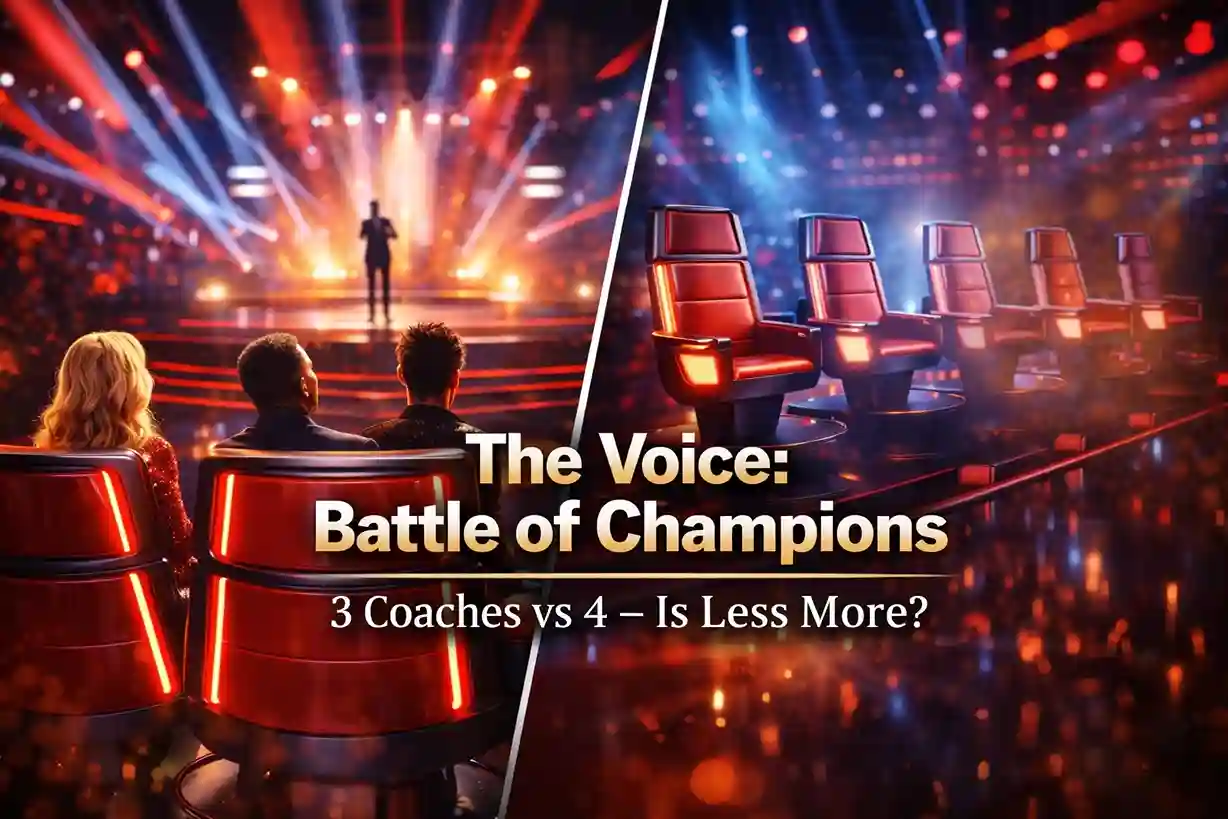
How The Voice: Battle of Champions Compares to Past Seasons – Is Less More?
The Voice has always thrived on its familiar formula: four superstar coaches, dramatic chair turns, and escalating battles toward a live finale.

Never Miss Your Chance to Audition!
Join our WhatsApp Channel for exclusive casting calls and audition alerts!
Join NowBut Season 29, subtitled The Voice: Battle of Champions and premiering February 23, 2026, on NBC, threw that blueprint out the window.
With only three coaches—Kelly Clarkson, John Legend, and Adam Levine, all former winners—the season strips away one red chair to create a leaner, fiercer competition. After the premiere’s Blind Auditions, the big question lingers: Does less truly equal more, or does the show miss the extra dynamic?
The Big Shift: Three Coaches Instead of Four
The change stems from NBC’s scheduling crunch—adding NBA games to primetime cut the episode order, making four-coach teams too small (around seven artists each) to feel substantial.
Executive producer Audrey Morrissey noted that tiny teams would be “ridiculous,” so they opted for three coaches with 10 artists apiece, totaling 30 competitors advancing to the Battles.
This isn’t just logistical; it’s a full rebrand as “Battle of Champions.” By featuring only proven winners (Kelly with four victories, Adam with three, John with one), the panel becomes an elite showdown.
No rookies or one-and-dones—every coach has skin in the game and bragging rights to defend. Kelly eyes a record 10th win, Adam seeks to reclaim his early-era dominance, and John aims to prove his single title was no fluke.
What the Premiere Showed: Amplified Drama vs. Lost Variety
Night 1 highlighted the pros and cons immediately.
Pros of the Three-Coach Format:
- Sharper Rivalries and Intensity: With fewer chairs, every turn counts more—no diluting attention across four opinions. Pitches got aggressive fast, like Adam’s reverse psychology on Jeremy Keith’s Triple Turn finale or Kelly’s Reba McEntire phone-in during country battles. The Triple Turn Competition (most three-chair turns wins a Super Steal in Battles) turned Blinds into a real leaderboard race—Adam snagged the early lead with two (Alexia Jayy and Jeremy Keith), ramping up stakes from the start.
- Cleaner Pacing and Focus: Episodes feel snappier without extra coaches vying for airtime. Standouts like Abigayle Oakley’s instant Triple Turn or Liv Ciara’s youthful belting got room to shine, and coach banter felt more personal and electric among longtime friends/rivals.
- Strategic Depth: Kelly capitalized on the lack of a dedicated country coach, scooping talents like Julia Golden and Abigayle Oakley. The smaller panel forces smarter building—teams feel more cohesive early on.
Cons and Comparisons to Past Seasons:
- Missing the Fourth Chair Energy: Traditional seasons (like Season 26 with Reba, Snoop, Niall, and Michael Bublé) thrived on diverse perspectives—pop, country, hip-hop, soul clashing in real time. Three chairs mean fewer bidding wars and no Blocks, reducing sabotage fun and some unpredictability.
- Fewer “Obvious” Mismatches: Past seasons loved the chaos of an artist ignoring genre fits (e.g., a rocker going to a pop coach). Here, choices feel more predictable—Jeremy Keith picked Adam over “obvious” John, but overall, the limited options narrowed some drama.
- Fan Divide: Early reactions are mixed. Some praise the “refreshed urgency” and “no filler,” calling it a needed shake-up after 28 seasons. Others miss the fuller panel, feeling it lacks variety or the classic four-chair frenzy that defined iconic moments.
Verdict: A Bold Evolution That Mostly Works
Compared to recent seasons (Season 28’s four-coach setup or Season 23’s Kelly-led run), Season 29 feels more urgent and focused.
The premiere proved the format can deliver high drama—Triple Turns created tension, coach chemistry popped, and Kelly’s early team depth (Abigayle, Julia, Jonah, Liv) set her as a frontrunner. The “less is more” approach streamlines excess while keeping the heart: emotional stories, vocal fireworks, and genuine rivalries.
But it trades some of the show’s signature sprawl for tightness. If you’re a fan of maximalist coach battles and genre diversity, you might miss the fourth chair. If you crave pure competition among elites, this feels like an upgrade.
As more Blind Auditions unfold, the true test will be whether the three-coach dynamic sustains excitement through Battles and beyond. So far, the Battle of Champions is proving that sometimes, trimming the panel makes the show sing louder.
Do you prefer the three-coach refresh or the classic four? Is this the reinvigoration The Voice needed, or do you want the old format back? Share your thoughts below as the season heats up!